From Digital Marketing to Growth Marketing: The shift that defines growth in the AI era
Digital Marketing: Focus on Impressions and Channels
For decades, digital marketing worked.
You ran ads.
You published content.
You generated leads.
As long as you launched campaigns, grew followers, and drove traffic to your website, growth followed.
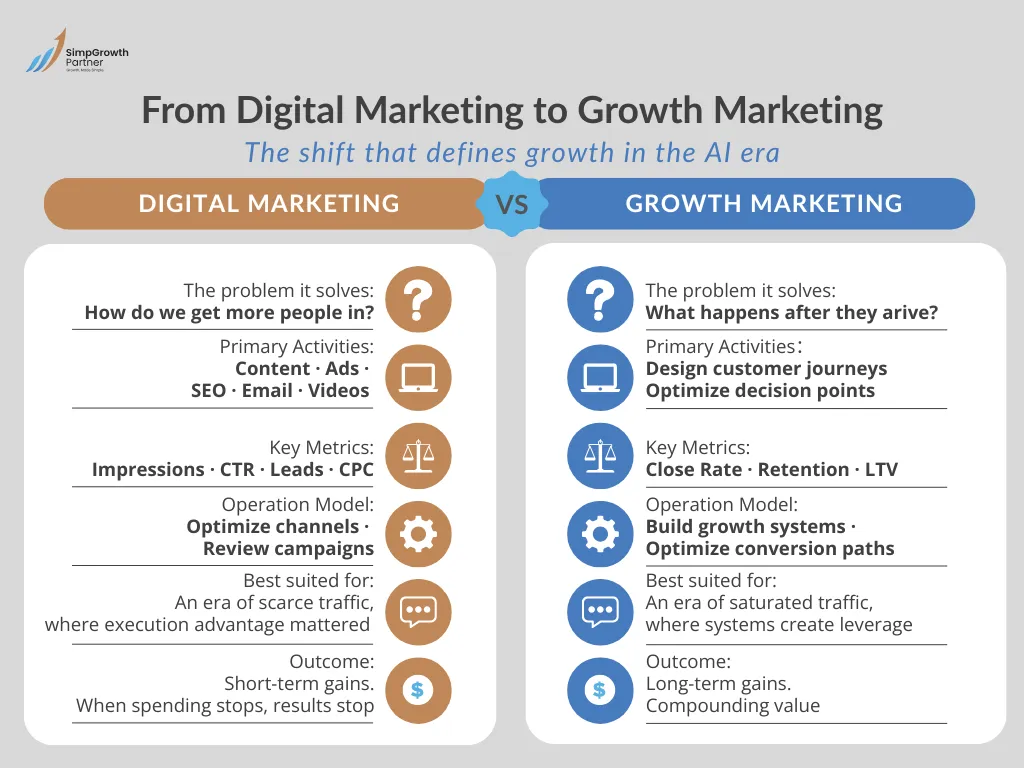
At its core, digital marketing revolves around one question:
How do we get more people in?
That question made perfect sense when visibility itself was a competitive advantage.
But this model has a built-in limitation:
Growth depends entirely on continuous input.
When spending stops, results stop.
In the AI era, when almost everyone can:
Generate content at scale
Optimize ads automatically
Run campaigns faster and cheaper
Execution stops being a differentiator. The real growth bottleneck shifts to a new question:
What happens after people arrive?
And that’s where Growth Marketing begins.
Growth Marketing: Focus on the Customer Journey
Growth marketing doesn't focus on optimizing channels, Instead, it optimizes the entire customer journey, from first touch to long-term loyalty.
It is built on systems, not campaigns.
Its focus is on:
Conversion paths
Retention mechanics
Referral loops
Compounding value over time
Instead of asking how to generate more traffic, it asks how to design growth systems that last.

The Shift in Practice: From Campaigns to Systems
Here’s how this shift plays out across the customer journey.
1. Awareness
Digital Marketing:
Maximizes reach through ads, posts, and promotions.
Growth Marketing:
Attracts the right audience with value-driven content that fits the system downstream.
AI’s role:
AI improves targeting and distribution, but only within a clear strategy.
2. Interest
Digital Marketing:
Relies on generic messaging and broadcast emails.
Growth Marketing:
Creates personalized experiences shaped by customer behaviors.
AI’s role:
AI adapts messaging, timing, and content automatically, at scale.
3. Consideration
Digital Marketing:
Depends on manual follow-ups and sales-heavy outreach.
Growth Marketing:
Build trust through relevant resources, delivered at the right moment.
AI’s role:
Predictive signals surface intent.
Automation delivers what matters most, without manual chasing.
4. Conversion
Digital Marketing:
Use discounts, urgency, and sales pressure.
Growth Marketing:
Designs frictionless paths around how people make decisions.
AI’s role:
Automation removes delays, confusion, and drop-offs in real time.
5. Loyalty
Digital Marketing:
Stops at the sale.
Growth Marketing:
Designs for retention, upsell, cross-sell and referrals.
AI’s role:
Retention systems, feedback loops, and referrals run continuously, without constant manual effort.
What This Shift Means for You
Growth Marketing wins not because it uses AI for content generation, but because AI amplifies systems that already work.
When your growth is system-driven:
Each process compounds
Each customer adds long-term value
Each funnel builds on the last
You’re no longer restarting with every campaign. You’re building momentum.
If your growth today depends on:
Constant ad spend
One-off campaigns
Manual follow-ups
Short-term spikes
You’re not behind, but you are operating with an outdated model.
And if you haven’t fully committed to any of the above yet, that’s not a disadvantage. It’s an opportunity.
The AI era isn’t about running more ads, producing more content, or posting on more channels.
It’s about upgrading the system behind your growth.
Final Takeaway:
Digital Marketing brings people in.
Growth Marketing makes growth last.
In an era where execution is automated, strategy and system design become the real leverage.
That’s the shift that defines growth in the AI era.
Next step:
👉 Run the Growth Bottleneck Self-Check
A quick self-check to see where your growth may be constrained, before you add more marketing tactics.


LinkedIn
Youtube